
Technical guide
What Is a VFD? How Variable Frequency Drives Work and Where to Use Them
Learn how a variable frequency drive controls an AC motor, what is inside a VFD, when it saves energy, and when another starting method is better.
Jack Dean writes practical VFD selection, wiring, replacement and power-quality guides using current manufacturer documentation and explicit procurement checks.
Author profile
A variable frequency drive (VFD) is an electronic power converter that controls the speed and torque of an AC motor by changing the frequency and voltage supplied to it. You may also see the terms AC drive, adjustable-frequency drive or, more broadly, variable-speed drive (VSD).
A motor connected directly to a fixed-frequency supply normally runs near one design speed. A VFD sits between the supply and motor so the machine can accelerate gradually, operate at the speed the process actually needs, reverse under controlled conditions and stop according to a programmed ramp.
That makes a VFD much more than an electronic on/off switch. It is the power stage, motor controller and a significant part of the machine protection and automation system.
VFD operation in one minute
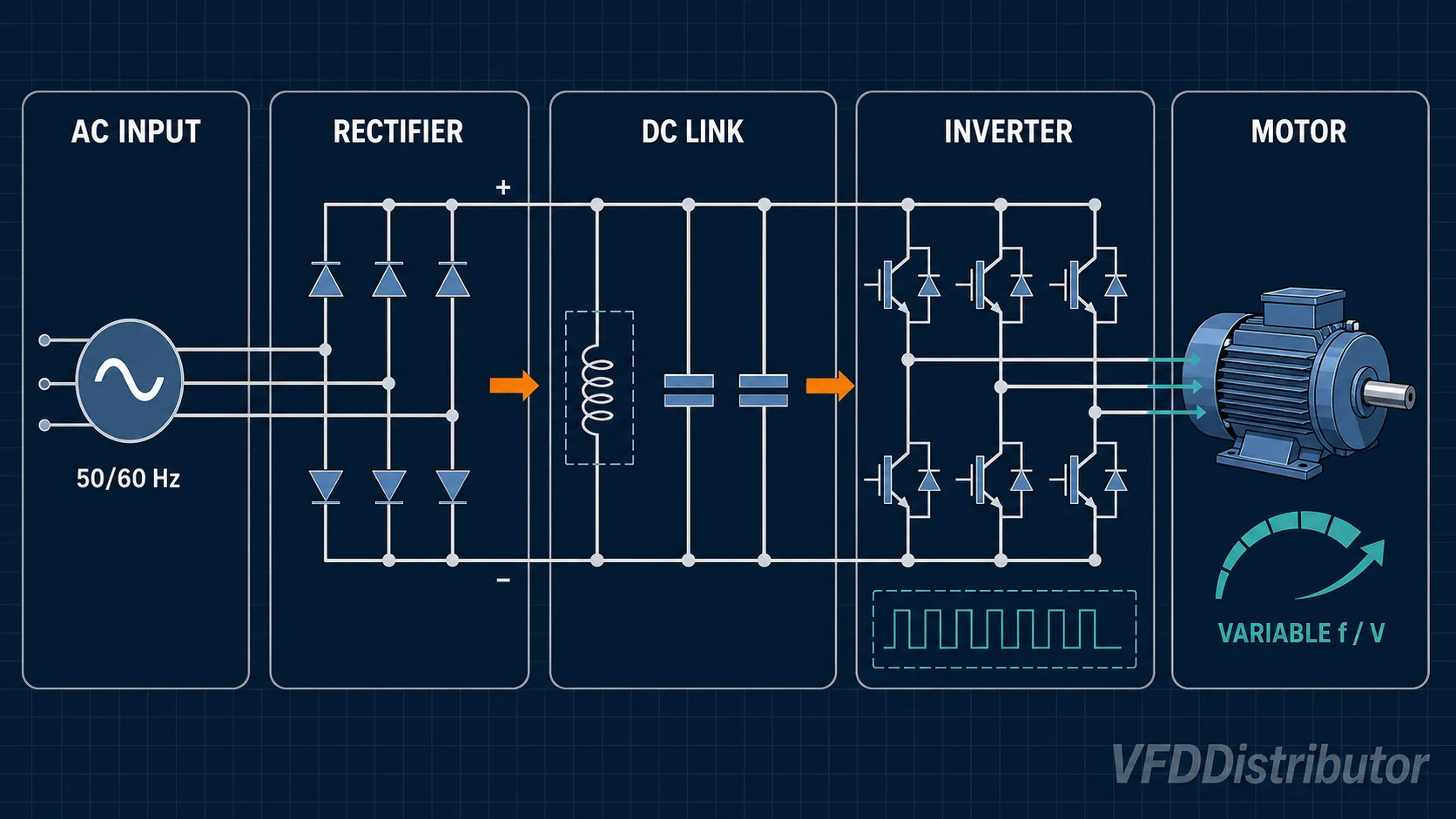
Most low-voltage AC VFDs have three main power sections:
- Rectifier: diodes or controlled semiconductor devices convert incoming AC power to DC.
- DC link: capacitors, and sometimes a DC choke, smooth and store energy on the internal DC bus.
- Inverter: insulated-gate bipolar transistors or another switching device turn the DC into a pulse-width-modulated output for the motor.
The inverter switches rapidly rather than producing a perfect sine wave. The motor's inductance responds to the fundamental voltage and current so that the drive can control magnetic flux, torque and speed. The drive's control board continuously calculates the required switching pattern from the speed command, motor data, measured current and selected control mode.
For an induction motor, synchronous speed is related to supply frequency and motor pole count:
Synchronous speed (rpm) = 120 × frequency (Hz) ÷ number of poles
A four-pole motor therefore has a synchronous speed of 1,500 rpm at 50 Hz or 1,800 rpm at 60 Hz. Its actual shaft speed is slightly lower when producing torque because an induction motor requires slip. A VFD changes frequency to change the magnetic field speed and adjusts voltage and current so that the motor can produce the required torque.
What a VFD controls
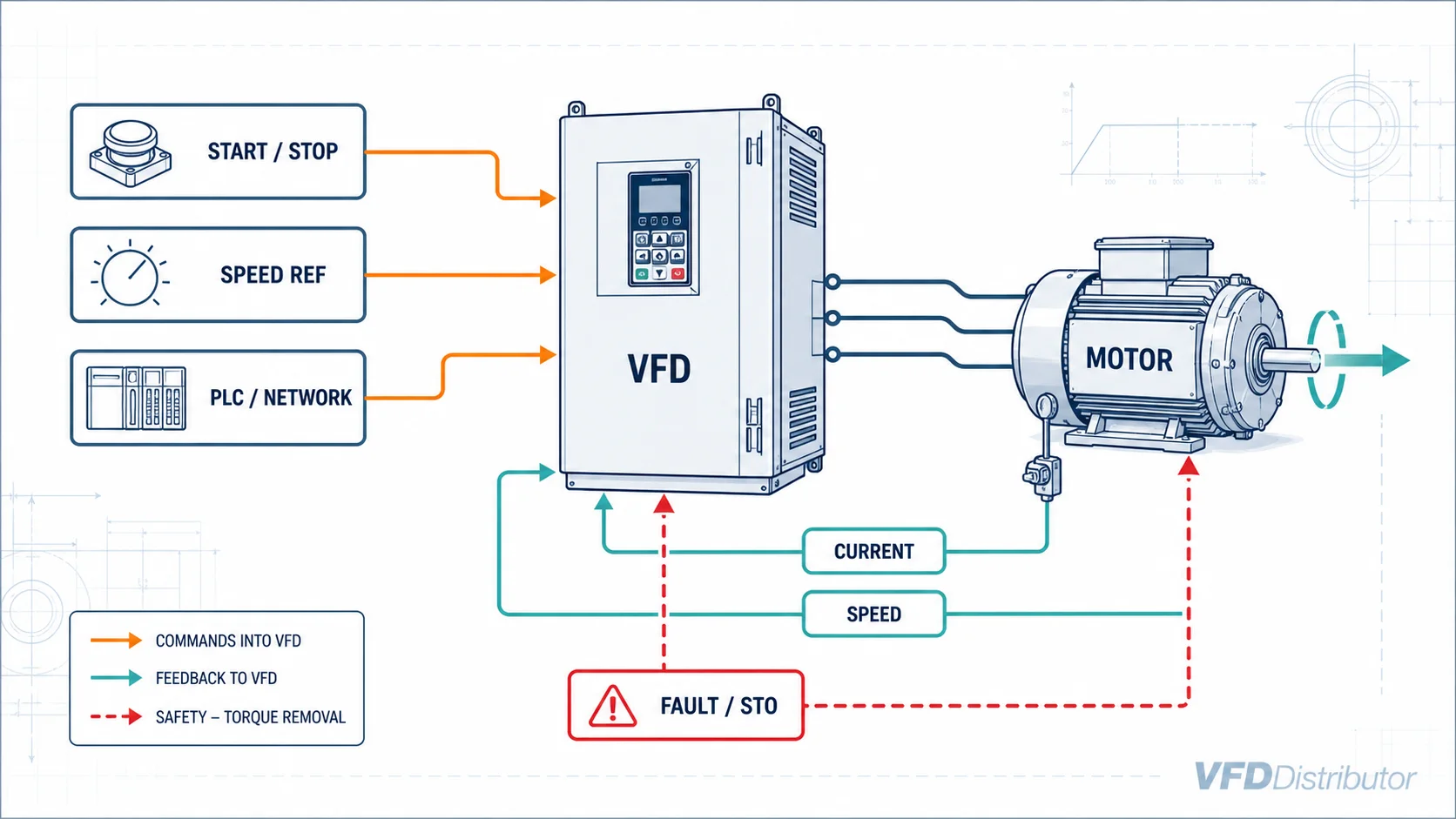
Depending on the product family and control mode, a drive can manage:
- Motor speed, torque or process pressure/flow
- Acceleration and deceleration ramps
- Forward and reverse direction
- Current and torque limits
- Motor thermal protection based on an electronic model or sensor
- Mechanical brake sequencing on suitable application drives
- Process control through an internal PID controller
- Multiple preset speeds, sleep/wake logic and pump alternation
- Communication with a PLC, building-management system or supervisory network
- Diagnostic history, maintenance counters and condition information
Basic V/f control maintains a programmed relationship between output voltage and frequency. Sensorless vector control uses a motor model and current measurements for better torque response without an encoder. Closed-loop vector control adds speed or position feedback for applications that need tighter regulation. These modes are not interchangeable; the load and performance requirement should determine the choice.
Why use a VFD?
Match the process instead of wasting energy
The strongest energy-saving case is usually a centrifugal pump or fan whose required flow changes. Throttling a valve or damper while the motor runs at full speed wastes pressure. Reducing motor speed can cut required power sharply because centrifugal-load power changes approximately with the cube of speed under suitable system conditions.
This does not mean every 20% speed reduction guarantees a fixed energy saving. Static head, system curve, motor and drive losses, minimum flow, operating hours and the actual duty cycle all matter. A lifecycle estimate should use measured or credible load-profile data.
Reduce starting stress
A direct-on-line motor start can create high current and abrupt mechanical torque. A VFD starts by raising frequency and voltage along a controlled ramp. This can reduce belt shock, water hammer, coupling stress and voltage disturbance. The actual starting current still depends on breakaway torque, acceleration time and drive sizing.
Improve process control
Speed control can hold pressure, flow, tension or line speed closer to a setpoint. Many drives can take a 0–10 V, 4–20 mA, pulse, digital or network reference and can return status and measurements to the control system.
Add useful diagnostics and protection
Modern drives detect conditions such as overcurrent, overvoltage, undervoltage, overtemperature, phase loss and earth faults within their stated capabilities. They also record fault codes and operating data. These features improve diagnosis, but they do not replace the correctly coordinated disconnect, short-circuit protection, grounding, machine safety and motor protection required by the design.
Common VFD applications
| Application | What the drive normally contributes | Selection issue that matters |
|---|---|---|
| Pumps | Pressure or flow control, soft filling, sleep mode | Minimum flow, dry-run protection, static head |
| Fans and blowers | Airflow control and energy reduction | Resonant speeds, minimum ventilation, flying start |
| Conveyors | Controlled start, speed matching and torque limit | Loaded starts, breakaway torque, braking |
| Mixers and extruders | Process-speed control and higher low-speed torque | Constant-torque duty, cooling, overload |
| Compressors | Capacity control and reduced cycling | Approved speed range, lubrication, unloading logic |
| Hoists and cranes | Torque control, brake coordination and smooth motion | Functional safety, feedback and regenerative energy |
| Machine tools | Spindle-speed range and automation | Constant-power range, dynamic response, motor type |
The application name alone is not enough. A centrifugal pump and a positive-displacement pump have different torque behavior; a horizontal empty conveyor and a loaded incline conveyor do too.
VFD, soft starter or direct-on-line starter?
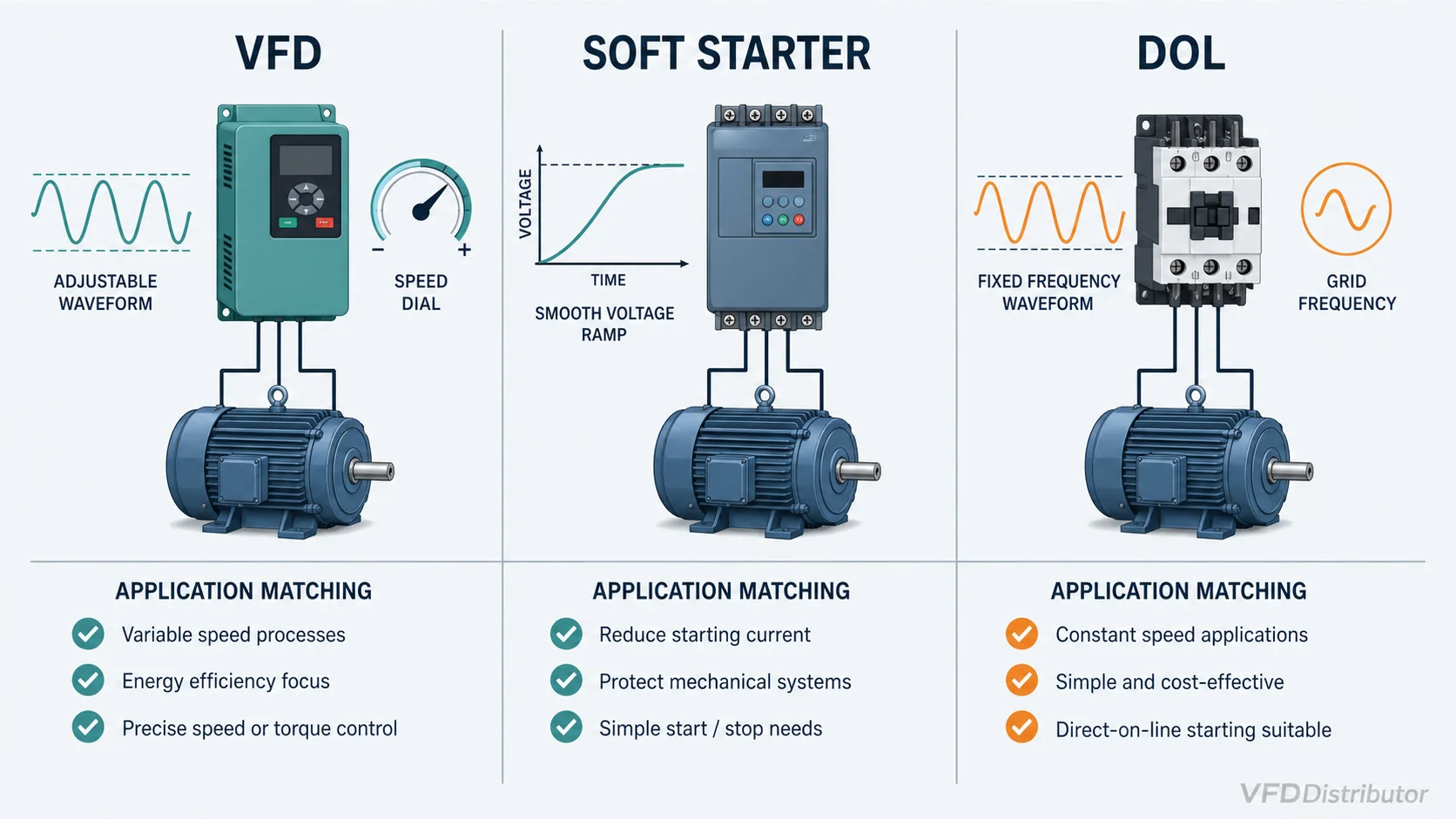
| Device | Best fit | What it does not provide |
|---|---|---|
| VFD | Continuous speed/torque control, process regulation, controlled acceleration | It is the most complex option and introduces switching, harmonic and thermal design considerations |
| Soft starter | Reduced electrical and mechanical stress during starting and stopping when the motor then runs at line frequency | Continuous variable-speed operation |
| Direct-on-line starter | Simple fixed-speed loads where the supply and machine tolerate full-voltage starting | Controlled acceleration or speed regulation |
If a motor only needs a gentler start and will then run continuously at full speed, compare a soft starter. A VFD is usually justified when variable speed, controlled torque, automation or drive-specific functions create real value.
What a VFD does not solve by itself
A drive cannot correct every motor-system problem. It does not:
- Create output voltage above its available DC-bus capability
- Make an undersized motor produce unlimited torque without overheating
- Guarantee energy savings on a constant-torque process with no need to reduce speed
- Eliminate the need for branch-circuit and short-circuit protection
- Make an unsuitable old motor immune to PWM insulation stress or bearing currents
- Dissipate regenerative energy without a suitable braking or regeneration path
- Make a machine safe without a risk assessment and correctly designed safety functions
- Meet a facility harmonic target merely because the product has a low input-current figure in one test condition
Treat the VFD as one component in a system that includes the supply, protective devices, enclosure, cooling, motor, cable, load, controls and operators.
Key ratings on a VFD nameplate or data sheet
Before comparing products, identify:
- Input voltage, frequency and phase
- Output voltage and continuous current
- Normal-duty and heavy-duty current/overload ratings
- Permitted motor types and control modes
- Ambient-temperature and altitude derating
- Enclosure or IP rating
- Short-circuit rating when installed with specified protection
- Built-in or optional EMC filter, DC choke and braking chopper
- Digital/analog I/O and communication options
- Safety functions such as Safe Torque Off, when present
Select by motor current, load duty and derating—not by kW or hp alone. Our 9-step VFD selection guide explains the complete process. Once the drive is selected, use the VFD wiring basics guide to plan the power, motor, control and grounding architecture, and review VFD harmonics and line reactors when input-current distortion or supply impedance matters.
Frequently asked questions
Can a VFD convert single-phase power to three-phase motor output?
Some drives are designed for single-phase input and three-phase output. Others permit it only with manufacturer-defined derating, and many do not permit it at all. Verify the exact input rating and manual; never assume that a standard three-phase-input drive can simply run with one phase missing.
Can one VFD run more than one motor?
It can be engineered to do so in some constant V/f applications, provided the drive covers the combined current and each motor has suitable individual protection. Motor identification, vector control and output switching become more complicated. Do not open a contactor between a running drive and motor unless the drive manufacturer and system design explicitly allow the sequence.
Does a VFD change motor horsepower?
It controls voltage, current and frequency; it does not create free mechanical power. Below base speed, many applications operate in an approximately constant-torque region, so available power falls with speed. Above base speed, voltage is limited and the motor may operate in a field-weakening, approximately constant-power region with declining torque. The permitted envelope depends on the motor and drive.
Is a VFD the same as an inverter?
“Inverter” technically names the DC-to-AC output stage, but the word is often used informally for the complete drive. In technical specifications, use the manufacturer's terminology and identify the complete product type and code.
Practical next step
To evaluate whether a VFD suits your machine, collect the motor nameplate, supply details, load type, required speed range, starting and stopping behavior, environment, cable length and control interface. Those facts determine whether a VFD is appropriate and which drive class is required.
If you share that information and the destination country, we can help compare current product families and replacement paths. For an obsolete unit, work through the VFD replacement checklist; for a new shortlist, compare the major VFD manufacturers. Send the application details through WhatsApp.
Technical references
Product ratings and terminology vary by exact series and region. Verify the current manufacturer manual and applicable electrical and machinery-safety requirements before design, installation or commissioning.